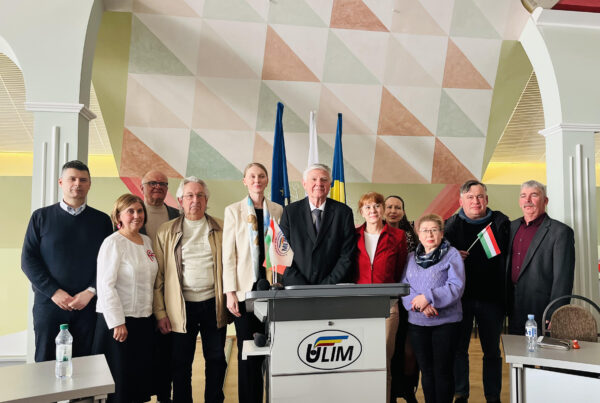
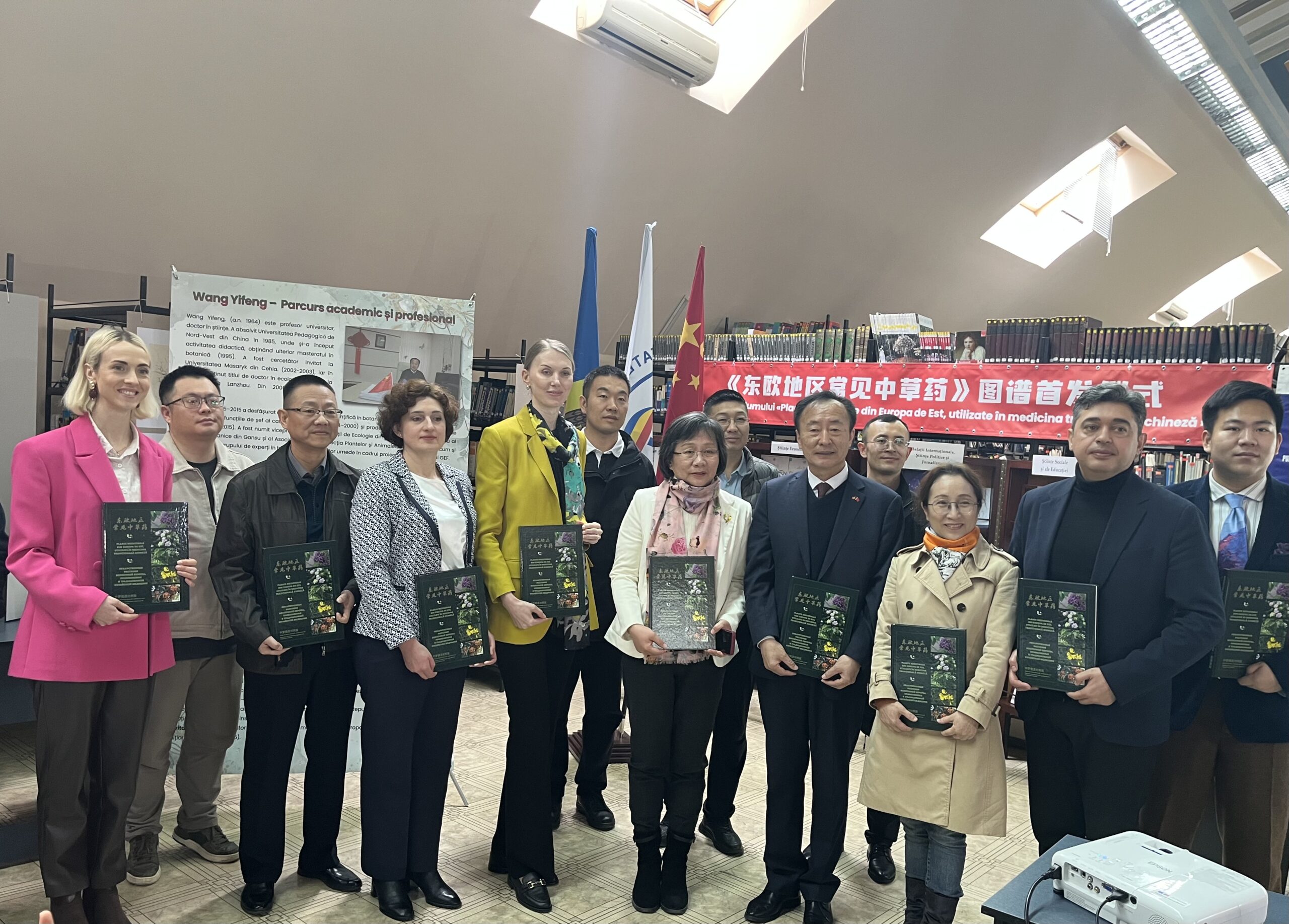
Chisinau, April 1, 2026 – The Free International University of Moldova (ULIM) hosted the launch event for the atlas “Medicinal Plants of Eastern Europe Used in Traditional Chinese Medicine,” held as part of the 18th edition of the “Scientia” Fair, a platform dedicated to academic dialogue and the promotion of scientific excellence.
The event was opened by Ms. Irina Cerneauscaite, Director of DIB, and brought together representatives from the diplomatic, academic, and medical communities, reflecting the steady development of cooperation between the Republic of Moldova and the People’s Republic of China.
A greeting was delivered by Her Excellency Ms. Dong Zhihua, Ambassador of the People’s Republic of China to the Republic of Moldova, who emphasized the importance of strengthening bilateral relations in the fields of education, research, and health. In her speech, Her Excellency highlighted the role of joint projects in bringing peoples closer together and in promoting friendship and the exchange of knowledge, commending the contribution of partner institutions to the development of Moldovan-Chinese cooperation.
In her speech, Dr. Valentina Ciumacenco, Associate Professor and Vice Rector for International Relations at ULIM, highlighted the interdisciplinary and intercultural nature of the work, as well as its role in promoting dialogue between traditional and contemporary medical systems. At the same time, she emphasized the importance of international academic partnerships and their contribution to the development of research, education, and the exchange of best practices among the institutions involved, expressing appreciation for the contribution of the author, the coordinators, and the institutional partners, as well as for the constant support provided by the Embassy of the People’s Republic of China in the Republic of Moldova.
On behalf of the Ministry of Health of the Republic of Moldova, Mr. Radu Plămădeală, Head of the Directorate for Public Policy Coordination and European Integration, highlighted the relevance of research in the field of phytotherapy and the importance of international cooperation in the development of health systems.
The author of the work, Mr. Wang Yiefeng, Ph.D. in Botanical Sciences, Director of the Confucius Institute at ULIM and professor at Northwest Normal University in China, presented the concept and process of compiling the atlas, highlighting the documentation effort carried out over several years.
In turn, Ms. Lucia Fișer, the project coordinator, a Doctor of Medical Sciences and head of the Moldovan Center for Traditional Chinese Medicine at the “Nicolae Testemițanu” State University of Medicine and Pharmacy, highlighted the importance of academic collaboration in the realization of this trilingual project.
The atlas “Medicinal Plants of Eastern Europe Used in Traditional Chinese Medicine” is a trilingual work (Chinese, Romanian, and Russian), produced by a team of professors from Northwest Normal University in China, in partnership with the “Nicolae Testemițanu” State University of Medicine and Pharmacy and the Confucius Institute at ULIM. The publication represents a valuable contribution to the development of contemporary phytotherapy and the strengthening of international scientific dialogue.
The book includes the research of Professor Wang Yiefeng, a specialist in botany who has been based in the Republic of Moldova since 2015, drawing on experience accumulated over more than 30 years of research. The work combines the traditions of Eastern European phytotherapy with the principles of traditional Chinese medicine.
Over the course of 7 years (2016–2022), the author took nearly 10,000 photographs of approximately 500 plant species, of which 247 were selected for the final version of the book. Thus, the book is an illustrated collection of 247 species of seed-bearing plants belonging to 77 botanical families in Eastern Europe, used for medicinal purposes.
Each species is presented through evocative images and detailed descriptions of its therapeutic effects and the main conditions it treats. The description of each species is provided in three languages: Chinese, Romanian, and Russian, to meet the needs of the academic and professional communities.
The event included discussions and remarks from participants, including representatives of the Center for Traditional Chinese Medicine in the Republic of Moldova, represented by Mr. Jin Jianjun, the Center’s director from China.
The event culminated in a book signing session with the author, as well as a cultural segment featuring a tasting of the traditional Chinese tea “Sanpao cha” from Gansu Province.
The book was published in a print run of 1,000 copies and is available for viewing at the DIB.